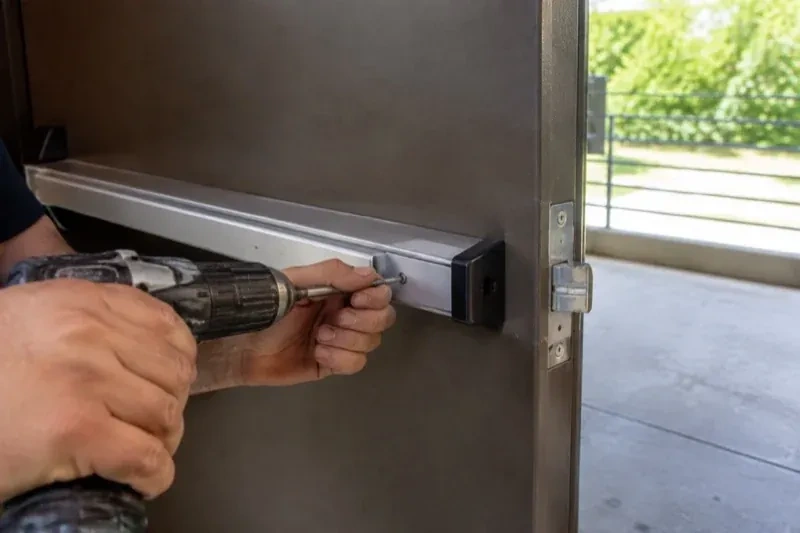
Commercial · Richmond Hill
Panic & Exit Hardware in Richmond Hill
The crossbar on the loading-dock door barely returns anymore. Someone has to lean into it with a shoulder, and twice this month it has stuck half-latched, propped by whatever was nearest.
Panic & Exit Hardware
In plain words
Electrified exit hardware adds a layer without changing the basic behaviour of the door: a person inside can still leave under one motion of the hand, every time. A request-to-exit switch tells an access-control panel that the pushpad or crossbar was actuated, usually paired with a door-position contact so the panel can also tell a normal exit from a forced or propped door. Electric latch retraction lets a fire-rated opening behave like a push-pull door for staff, provided it relatches automatically on a fire-alarm signal, since that kind of door never carries a mechanical dogging function. An alarm module sounds when the device is used.
How the visit goesThe fire inspector's note is blunt: the banquet hall's second exit still turns on a deadbolt, and the crowd it is rated to hold needs a door that opens under one motion, no key involved.
Richmond Hill
How the visit goes
Occupancy, fire rating and the authority reviewing the space
The assessment records the occupancy type and calculated occupant load for the room the door serves, whether the door sits in a fire separation, and who the authority having jurisdiction is likely to be, whether that is a fire inspector, a building official or an insurer. These facts, not the door's appearance or its width alone, are what decide whether a releasing device is required, whether it must also be fire-rated exit hardware, and what documentation the finished installation should carry.
Labelling, signage and the dogging key
Any signage the opening needs, such as a label identifying the door as an exit or noting an alarm, is fitted alongside the hardware rather than left for later. Where the device carries a dogging function on a standard opening, the key or keyed cylinder for it is handed to whoever the building's management names as responsible, along with an explanation of when dogging is appropriate; on any door that sits in a fire separation, mechanical dogging is left off the device entirely and is never installed as a management choice.
Electrified functions folded into the building's other systems
Any request-to-exit signal, latch retraction or alarm added during the visit now does its own specific job rather than one combined function: an alarm module can sound locally on its own power the moment the crossbar is used, latch retraction lets an authorized signal release the latch for entry, and a request-to-exit signal tells the access-control panel that the pushpad was actuated. None of them alone proves who passed through or from which side, and the exit function itself remains entirely mechanical underneath, so a power interruption still leaves the door able to be pushed open by hand from the inside.
Panic & Exit Hardware
In the van
- Astragal and mullion hardware
- Installation template and jig
- Signage and labels
- Through-fixings and mounting hardware
- Force gauge
What affects the quote
Same fees day, night or weekend
1Fire-rated versus non-rated opening
A fire-rated door needs hardware specifically listed for that assembly and installed to keep the rating intact, which is more involved than fitting a standard device to a non-rated door.
2New preparation or existing cut-outs
A door with no prior hardware needs new holes cut and reinforced to the device's template. A door already prepared for a similar device, even an old one, is often a simpler fit with less new drilling.
3Number of keys or dogging cylinders
Cutting keys for the outside trim and providing a dogging key or keyed dogging cylinder for the device is counted individually, the same way any keyed hardware is.
Panic & Exit Hardware: questions
What outside trim options exist for an exit device?
A plain pull suits a door nobody needs to lock from outside. A lever with a key cylinder lets authorized people turn the handle and enter while the inside stays a simple push. A keyed cylinder alone, without a lever, suits occasional entry where a full handle is not needed. All three leave the inside crossbar untouched, since the trim only ever affects the outside.
Who is responsible for keeping the hardware compliant?
The building owner or the party the owner assigns, often a facilities manager, is responsible for keeping exit hardware in working order and for the fire door assembly testing that goes with it. A locksmith installs and services the hardware and can keep records on the owner's behalf, but the ongoing duty to maintain the assembly sits with whoever holds the building.
When does a door actually need this hardware rather than a regular lock?
It comes down to occupancy and occupant load rather than preference. Rooms used for assembly, such as banquet halls, places of worship or gyms, and doors serving a stairway in a busier building, are where this hardware becomes the standard choice instead of a keyed lock on the exit side. A fire inspector or building official is the practical way to confirm whether a specific room has crossed that line.
Commercial Locks

- Master Key System DesignA new hire at the shop gets handed whatever spare key happens to be in the drawer, and it turns out…
- Access Control InstallationAnother employee left and the keys never came back.
- Commercial-Grade Lock ReplacementA new tenant moved into the unit next door, and the property manager just found three different…
Panic & Exit Hardware near you
The pages that follow describe the lock services offered in Richmond Hill one by one, without sales talk. Where a service has a simpler or less involved cousin, the page says so. Where a repair will do instead of a replacement, the page says that too. The aim is for you to choose well, not to choose more.