Commercial · Richmond Hill
Panic & Exit Hardware
The crossbar on the loading-dock door barely returns anymore. Someone has to lean into it with a shoulder, and twice this month it has stuck half-latched, propped by whatever was nearest.
Panic & Exit Hardware
In plain words
Which device goes on a door depends on what the door already is. A single interior door usually takes a rim exit device and a simple pull or lever outside. Listed fire-exit hardware covers many tall, narrow-stile and fire-rated openings too, so a mortise or vertical-rod device is chosen for its latching arrangement or the door's own preparation, not from height or fire rating alone, and a fire-rated opening can never be held open by a mechanical dogging function. Reading the door correctly before ordering hardware is most of the job; fitting it well is the rest.
How the visit goesSomeone at the front counter always has to unlock the side door by hand before the lunch rush, because the round doorknob out there was never meant to be an exit for a room this size.
Richmond Hill
How the visit goes
Occupancy, fire rating and the authority reviewing the space
The assessment records the occupancy type and calculated occupant load for the room the door serves, whether the door sits in a fire separation, and who the authority having jurisdiction is likely to be, whether that is a fire inspector, a building official or an insurer. These facts, not the door's appearance or its width alone, are what decide whether a releasing device is required, whether it must also be fire-rated exit hardware, and what documentation the finished installation should carry.
Choosing the device for the opening
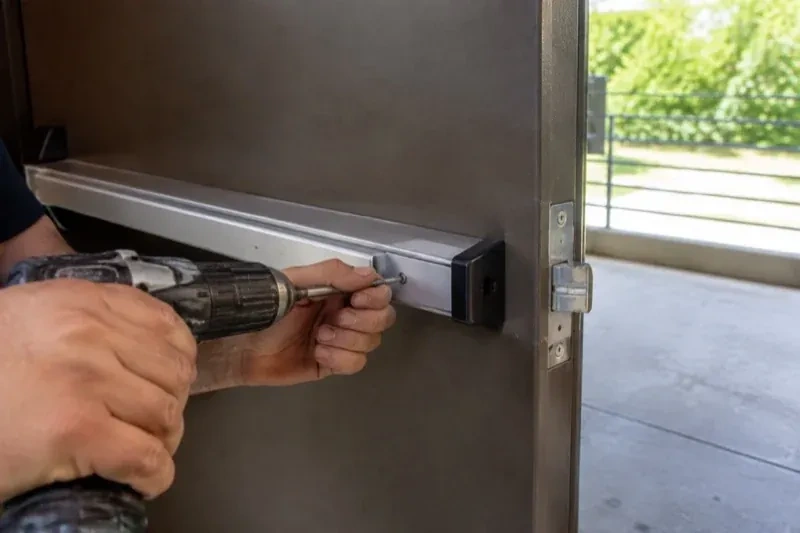
With the assessment done, the locksmith matches a device family to the door: a rim exit device for most single doors, a mortise device where a heavier-duty case suits the opening, or a vertical-rod device where latching is needed at both the top and bottom of the frame. Fire-rated openings take fire exit hardware specifically listed for that duty, never a standard panic device pressed into a role it was not built for, and listed rim fire-exit hardware covers a wide range of those openings on its own. The chosen device is matched to the door's width, handing and existing preparation before it is ordered.
Room to grow into the next change
If the space changes use again, adds seating, or the occupant load creeps upward with a future renovation, the hardware fitted now is already suited to a use that requires it, rather than something that will need revisiting the moment the room grows busier. Keeping a note of the occupant load the current hardware was specified for means a future change can be checked against that number before it becomes an inspector's finding rather than a planned upgrade.
Panic & Exit Hardware
In the van
- Astragal and mullion hardware
- Installation template and jig
- Signage and labels
- Through-fixings and mounting hardware
- Force gauge
What affects the quote
Same fees day, night or weekend
1Outside trim selected
A plain pull is the simplest outside trim. A lever with a key cylinder, or a trim matched to other hardware finishes in the building, involves more parts and more fitting time.
2Number of keys or dogging cylinders
Cutting keys for the outside trim and providing a dogging key or keyed dogging cylinder for the device is counted individually, the same way any keyed hardware is.
3Occupancy and code documentation needed
A project with a fire inspector's note or a building official's requirement attached usually needs a more detailed written record than a straightforward upgrade an owner requests on their own initiative.
Panic & Exit Hardware: questions
What outside trim options exist for an exit device?
A plain pull suits a door nobody needs to lock from outside. A lever with a key cylinder lets authorized people turn the handle and enter while the inside stays a simple push. A keyed cylinder alone, without a lever, suits occasional entry where a full handle is not needed. All three leave the inside crossbar untouched, since the trim only ever affects the outside.
Who is responsible for keeping the hardware compliant?
The building owner or the party the owner assigns, often a facilities manager, is responsible for keeping exit hardware in working order and for the fire door assembly testing that goes with it. A locksmith installs and services the hardware and can keep records on the owner's behalf, but the ongoing duty to maintain the assembly sits with whoever holds the building.
When does a door actually need this hardware rather than a regular lock?
It comes down to occupancy and occupant load rather than preference. Rooms used for assembly, such as banquet halls, places of worship or gyms, and doors serving a stairway in a busier building, are where this hardware becomes the standard choice instead of a keyed lock on the exit side. A fire inspector or building official is the practical way to confirm whether a specific room has crossed that line.
Commercial Locks

- Master Key System DesignA new hire at the shop gets handed whatever spare key happens to be in the drawer, and it turns out…
- Access Control InstallationAnother employee left and the keys never came back.
- Commercial-Grade Lock ReplacementA new tenant moved into the unit next door, and the property manager just found three different…
Panic & Exit Hardware near you
The pages that follow describe the lock services offered in Richmond Hill one by one, without sales talk. Where a service has a simpler or less involved cousin, the page says so. Where a repair will do instead of a replacement, the page says that too. The aim is for you to choose well, not to choose more.